
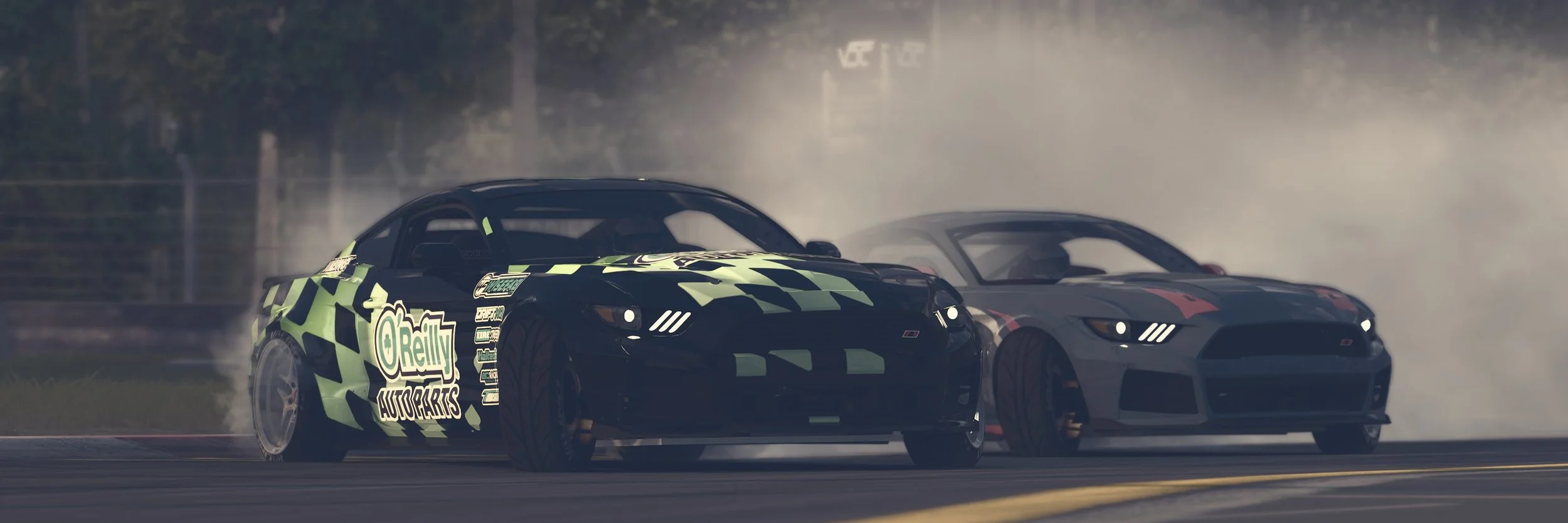
Drift Games
Drift Games is a competitive format built to bring structure, energy, and purpose to the drift session. The idea started back in Forza Motorsport 3, where these games helped build team morale and gave drivers a new way to compete, improve, and stay engaged beyond normal tandem runs.
Over time, Drift Games became more than just something fun to do in a lobby. They created real challenges that rewarded car control, consistency, pressure handling, and adaptability, while also bringing drivers together through shared competition.
Today, many people still do not fully understand how Drift Games work, which is why Kyoto Motorsport is using this page to explain the format clearly. As the team continues to grow, these games will be used in weekly sessions, special events, and driver development to keep competition strong, morale high, and the Kyoto standard moving forward.
Limbo
Limbo is a precision gap-clearance drift game that uses two parked cars as the “gate,” with one active driver on course at a time and each launch leaving the line at 5-second intervals.
The goal is to drift cleanly through a shrinking gate, complete the pass, turn around, and repeat in the opposite direction as the gap gets tighter each round.
Format
Solo attempt format, one active driver at a time.
Two parked cars form the gate.
Drivers leave the start line at 5-second intervals.
One round consists of one pass through the gate, then all drivers who make it through turn around and attempt the same challenge in the opposite direction.
After each completed round, the gate narrows by 1/2 car-width on each side.
Win and fail
A round only counts as successful if the driver fully clears the gate and exit zone without contact, spin, or leaving the course.
The event winner is the driver who achieves the cleanest clearance through the narrowest successful gap.
Win condition: clean clearance through the narrowest successful gap.
Fail condition: contact with either gate car.
Fail condition: wall tap.
Fail condition: spin.
Fail condition: two wheels off.
Fail condition: stopping before full exit
Round flow
Round 1: comfortable gap, used as the confidence-building opener.
Round 2: moderate squeeze, forcing a cleaner line and better placement.
Round 3 and beyond: continue narrowing the gate until only one driver remains clean.
Sticks
Sticks is a drift obstacle-survival game where one volunteer becomes the first “stick,” and every other driver must complete the course without hitting that stick, spinning, going off track, or hitting a wall.
The pressure comes from forcing each driver to solve the same obstacle cleanly, while the first driver to hit the original stick becomes the next starting stick for the following round.
Format
One driver volunteers to become the first stick.
The stick may park anywhere within track limits.
The stick may orient the car however they want, including sideways, nose-out, or backwards, as long as the car remains inside the allowed area.
All non-stick drivers must attempt the course one at a time or in pairs (tandem) and make it around the sticks cleanly.
A round continues until all remaining drivers have made their attempt.
The first driver to hit the original stick becomes the next starting stick for the next round.
The event is run best of three, meaning the first to 2 round wins takes the event.
A successful run only counts if the driver completes the course without touching the stick car or making a major mistake.
The round winner is the last clean surviving driver, and the overall event winner is the driver who wins best-of-three rounds.
Win condition: be the last driver to complete a clean run in the round.
Event win condition: win 2 rounds
Fail condition: contact with the stick.
Fail condition: spin.
Fail condition: going off track.
Fail condition: hitting a wall.
Round 1: one volunteer becomes the first stick.
All other drivers attempt to drift around that stick cleanly.
The first driver who hits the original stick becomes the next round’s starting stick.
Continue until one driver remains as the clean round winner.
Reset and repeat until one driver wins 2 rounds.
King of the Hill 👑
King of the Hill is a rotating style event in survival mode.
When a run ends, the corner judges call their section winners, the driver with the most corner wins takes the battle, and the first corner judge in line becomes the next challenger.
Rotation
All non-battling drivers are assigned as corner judges along the route.
Corner judges are placed in a running order.
After each battle is completed and judged, the first corner judge in line rotates out of their judging position.
That first corner judge becomes the next driver in line for the tandem battle.
The battle winner stays on.
The next challenger comes from the rotating corner judge line.
Judging flow
This makes the event self-cycling because every driver will eventually move from judging into competition, then back into the rotation after their battle run ends.
It also keeps the queue fair, since the next challenger is determined by judge order rather than by random call-outs.
Each corner judge calls the winner of their section after the run.
The driver with the most corner wins takes the battle.
The winner stays on and moves one step closer to becoming King of the Hill.
The first corner judge in line becomes the next challenger.
Overall win condition
Each battle win is still tracked by corner votes (per-run).
But the overall event winner is the driver who manages the longest continuous run as lead.
If Driver A starts as lead and never loses, Driver A wins the event.
If Driver A wins a bunch of battles but eventually loses to Driver B, Driver A’s “streak length” is recorded.
Now Driver B becomes lead and must run the rest of the challenger line.
If Driver B beats all remaining challengers, you compare streaks.
If B’s continuous lead run is longer than A’s, B wins overall.
If A’s was longer, A remains overall King despite losing late.
The winner of King of the Hill is considered the best overall driver and keeps the crown (and bragging rights) until King of the Hill is run again.
Drift Games is more than a set of rules; it is part of the competitive spirit behind Kyoto Motorsport. What started years ago as a way to build morale and bring drivers together has grown into a format that continues to challenge skill, strengthen the team, and create meaningful competition.
As Kyoto Motorsport moves forward, Drift Games will remain part of our weekly sessions, special events, and driver development. It is one of the ways we keep the community engaged, the competition sharp, and the Kyoto standard moving forward.